Melqirana
Luma Pack
Luma Pack
Impossible de charger la disponibilité du service de retrait
- :card_index_dividers: Digital file available after purchase
- :books: Long-term availability
- :closed_lock_with_key: Secure checkout
- :sparkles: Content updated in 2026
Self-paced learning overview
1. Problem Statement
After learning initial vocabulary and foundational phrases, learners need to understand how those elements work in a broader context. Knowing greetings and a few short sentences alone does not provide enough material for describing daily actions, people, objects, and places. Verbs, word agreement, and choosing suitable forms within a sentence can also create difficulty at this stage. Vocabulary needs to expand gradually without turning study into simple memorization of disconnected word lists. A structured approach is therefore useful for connecting new vocabulary with practical language patterns.
2. Solution
Luma Pack organizes the next stage of study around familiar everyday themes. New vocabulary is introduced through sentences, short descriptions, and small dialogues so learners can see each word within context. The course gives particular attention to common verbs, descriptive vocabulary, and foundational grammar patterns. Each module combines explanation with exercises for building original sentences and identifying language structures. At the end of the course, the main topics are brought together in a review section that connects vocabulary, grammar, and practical use.
3. What's Inside
-
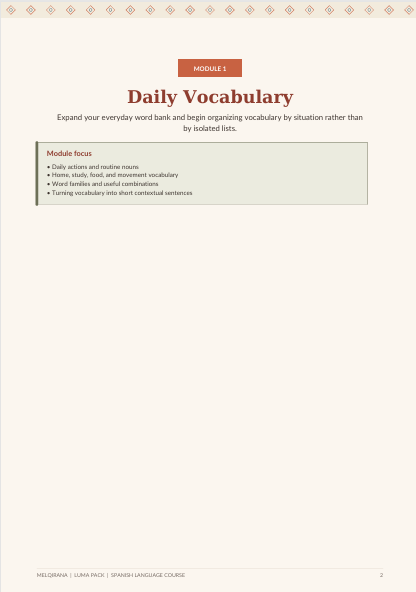
Module 1: Daily Vocabulary
Vocabulary for describing everyday objects, actions, places, and common daily situations. -
Module 2: People & Descriptions
Words for describing appearance, personality, age, foundational personal characteristics, and relationships between people. -
Module 3: Core Verbs
An introduction to common verbs and their use in short sentences. -
Module 4: Present-Time Patterns
Foundational structures for describing regular actions and activities happening in a particular situation. -
Module 5: Places Around You
Vocabulary for describing home, learning spaces, city locations, and basic orientation situations. -
Module 6: Describing Objects
Practice with colors, sizes, shapes, quantities, and other characteristics of objects. -
Module 7: Everyday Questions
A broader set of question structures for asking about people, objects, places, and actions. -
Module 8: Short Conversations
Small dialogues covering introductions, daily activities, places, objects, and common questions. -
Module 9: Reading Small Texts
Short learning texts that combine familiar vocabulary with new words that can be understood through context. -
Module 10: Luma Review Map
A review section covering verbs, descriptive vocabulary, questions, sentence patterns, and short texts.
4. Who Is This For?
✅ Suitable if you:
- already know foundational greetings and several short Spanish phrases;
- want to gradually expand your vocabulary;
- want to understand how common verbs work in sentences;
- plan to practise describing people, objects, and places;
- prefer a structured progression from explanation to practice;
- want to work with short texts and dialogues;
- have completed Free Guide or already know similar introductory topics.
❌ Not suitable if you:
- have not yet studied foundational vocabulary or basic Spanish sentence structure;
- are looking mainly for complex grammar topics;
- already read long texts comfortably and work with advanced language structures;
- need terminology for a narrow professional field.
5. What You'll Learn
While working through Luma Pack, you will study:
- approximately 70–100 new words across everyday topics;
- common verbs used to describe actions;
- foundational sentence patterns with verbs;
- vocabulary for describing people and objects;
- colors, sizes, quantities, and other characteristics;
- vocabulary related to home and city locations;
- a broader range of question structures;
- ways to form short responses;
- simple descriptive sentences;
- short thematic dialogues;
- reading short paragraphs;
- identifying the main information in small texts;
- creating original sentences with newly introduced vocabulary.
Practical Course Markers
During the exercises, learners work with sentences of approximately 5–10 words, create short descriptions of people and objects, and answer questions based on small reading passages. Some activities involve selecting a suitable verb form, restoring word order, and completing sentences with new vocabulary. Learners also practise building short dialogues from a provided situation. The final section combines material from several modules into one structured review.
6. Course Information & Support
Luma Pack is the second course in the Melqirana learning sequence and builds on the foundational topics introduced in Free Guide. The materials are designed around gradual vocabulary expansion, grammar patterns, and practice with short texts. The course is educational in format and does not define a specific language level as an automatic result of completion. Individual progress depends on study regularity, revision, practice, and previous learning experience. Questions about course structure or learning materials can be submitted through the Contact page.
7. Certificates & Credentials
After completing Luma Pack, the learner receives a digital Melqirana certificate showing the name of the completed course.
How are Melqirana materials organized?
How are Melqirana materials organized?
Each course is divided into thematic modules. The modules combine explanations, examples, vocabulary sections, short exercises, reading, and situations for practical Spanish use. The courses are arranged in a sequence that gradually expands the range of topics.
Do I need previous knowledge of Spanish?
Do I need previous knowledge of Spanish?
Not for every course. The introductory materials begin with foundational topics, while later courses gradually introduce broader vocabulary, grammar, reading, and language practice. Each course page indicates its place within the learning sequence.
Share