Melqirana
Origin Set
Origin Set
Impossible de charger la disponibilité du service de retrait
- :card_index_dividers: Digital file available after purchase
- :books: Long-term availability
- :closed_lock_with_key: Secure checkout
- :sparkles: Content updated in 2026
Self-paced learning overview
1. Problem Statement
After studying foundational vocabulary and short sentence patterns, learners need to begin connecting several ideas within one statement. At this stage, it can be difficult to keep track of who performs an action, when it takes place, and which words are suitable for describing the situation. Time markers, sequence, and connections between sentences also become more important. Very short phrases are no longer enough for describing a daily routine, plans, events, or personal experiences. A further structured stage is therefore useful for bringing separate language elements together into larger units of meaning.
2. Solution
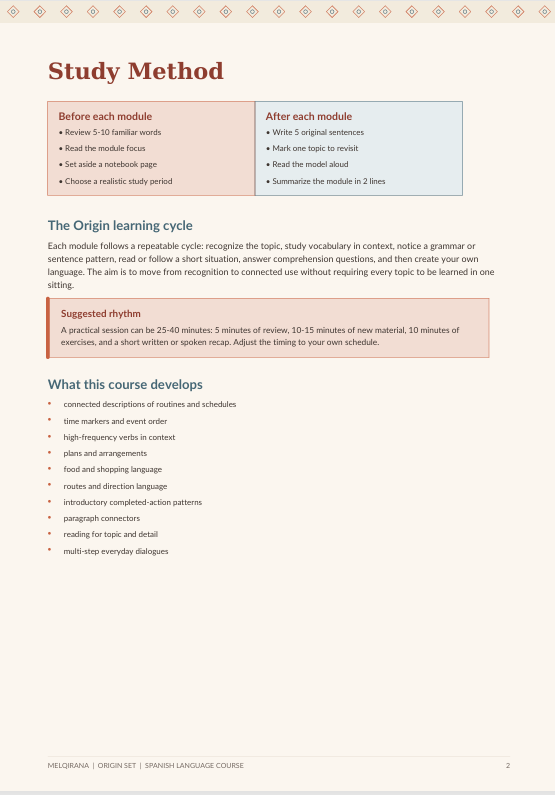
Origin Set is organized around thematic situations where learners work with several connected sentences. Vocabulary appears together with time expressions, verbs, and patterns used to describe the order of events. Individual modules cover daily routines, plans, places, food, shopping, and short descriptions of events. Activities gradually move from individual sentences toward small paragraphs, dialogues, and thematic texts. The final section combines vocabulary, grammar patterns, and contextual practice in mixed review activities.
3. What's Inside
-
Module 1: Daily Routine
Vocabulary and sentence patterns for describing morning, daytime, and evening activities, as well as regular daily tasks. -
Module 2: Time & Sequence
Clock time, parts of the day, days of the week, time expressions, and structures for explaining the order of events. -
Module 3: Verbs in Context
Practice with common verbs in broader sentences and thematic situations. -
Module 4: Plans & Intentions
Language patterns for describing simple plans, intentions, and future actions in everyday contexts. -
Module 5: Food & Everyday Choices
Vocabulary related to food, drinks, preferences, quantities, and common choice-based situations. -
Module 6: Shopping Situations
Words and structures for describing items, quantities, characteristics, and common shopping situations. -
Module 7: Getting Around
Vocabulary related to routes, directions, locations, and short questions about reaching a place. -
Module 8: Past-Time Introduction
An introduction to language patterns used for describing completed actions and short events that already happened. -
Module 9: Connected Sentences
Words and structures used to connect two or more sentences into a short, coherent paragraph. -
Module 10: Short Thematic Texts
Reading small texts about daily routines, travel, shopping, food, and everyday events. -
Module 11: Guided Dialogue Practice
Structured dialogues where learners complete lines, create responses, and work with situational context. -
Module 12: Origin Review Map
A concluding section reviewing time expressions, verbs, sentence patterns, dialogues, and thematic vocabulary.
4. Who Is This For?
✅ Suitable if you:
- already know foundational vocabulary and simple sentence patterns;
- can introduce yourself and describe individual people or objects;
- want to practise talking about daily actions and events;
- want to work with time expressions and sequencing;
- are ready to move from individual phrases toward short paragraphs;
- want to read thematic texts made up of several sentences;
- have completed Luma Pack or already know similar material.
❌ Not suitable if you:
- are not yet familiar with foundational Spanish word order;
- have not worked with common verbs or question structures;
- are mainly looking for complex literary text study;
- need narrow terminology for a specialized field.
5. What You'll Learn
While working through Origin Set, you will study:
- vocabulary for describing daily routines;
- common time words and expressions;
- days of the week and parts of the day;
- sentence patterns for describing sequences of actions;
- broader use of common verbs;
- foundational structures for plans and intentions;
- vocabulary related to food and everyday choices;
- words and phrases for shopping situations;
- introductory vocabulary for routes and directions;
- initial patterns for describing past events;
- connecting words between sentences;
- short thematic paragraphs;
- dialogue building from a given situation;
- reading texts of approximately 4–8 sentences;
- locating specific information in short texts.
Practical Course Markers
During the activities, learners create descriptions of their day using several connected sentences, work with time markers, and arrange events in a logical order. Some tasks involve writing short answers to questions, completing dialogues, and creating small thematic paragraphs. Reading activities ask learners to identify the main topic, locate specific details, and match information with questions. The course also includes introductory practice with past and planned actions using foundational language patterns. The concluding section combines several activity types to review the course material.
6. Course Information & Support
Origin Set is the third course in the Melqirana sequence and builds on vocabulary and grammar patterns introduced in Free Guide and Luma Pack. The course focuses on fuller sentences, time expressions, dialogues, and short thematic texts. It is educational in format and does not define a specific language level as an automatic result of completion. The amount of material retained depends on study frequency, revision, practice, and previous learning experience. Questions about course materials or structure can be submitted through the Contact page.
7. Certificates & Credentials
After completing Origin Set, the learner receives a digital certificate reflecting completion of this stage in the learning series.
How are Melqirana materials organized?
How are Melqirana materials organized?
Each course is divided into thematic modules. The modules combine explanations, examples, vocabulary sections, short exercises, reading, and situations for practical Spanish use. The courses are arranged in a sequence that gradually expands the range of topics.
Do I need previous knowledge of Spanish?
Do I need previous knowledge of Spanish?
Not for every course. The introductory materials begin with foundational topics, while later courses gradually introduce broader vocabulary, grammar, reading, and language practice. Each course page indicates its place within the learning sequence.
Share