Melqirana
Trail Pathway
Trail Pathway
Impossible de charger la disponibilité du service de retrait
- :card_index_dividers: Digital file available after purchase
- :books: Long-term availability
- :closed_lock_with_key: Secure checkout
- :sparkles: Content updated in 2026
Self-paced learning overview
1. Problem Statement
At this stage, learners can already work with longer texts and structured responses, but the challenge increases as finer differences in meaning begin to appear. Two similar expressions may communicate a different tone or intention depending on the context. In longer texts, the main idea may develop gradually across several paragraphs, while relevant information can be presented indirectly. Writing also requires more than communicating content: arguments, examples, and transitions need to be organized logically. This stage therefore calls for closer attention to structure, wording, and contextual clues.
2. Solution
Trail Pathway is built around thematic materials where learners analyze meaning, structure, and relationships between different parts of a text. Activities involve comparing similar expressions, identifying their role, and choosing wording that matches a particular situation. Individual modules focus on text logic, argumentation, implied information, paragraph transitions, and broader writing. Reading gradually moves from locating individual facts toward analyzing overall position, intention, and development of ideas. The final part of the course combines these elements through integrated reading, writing, and contextual analysis activities.
3. What's Inside
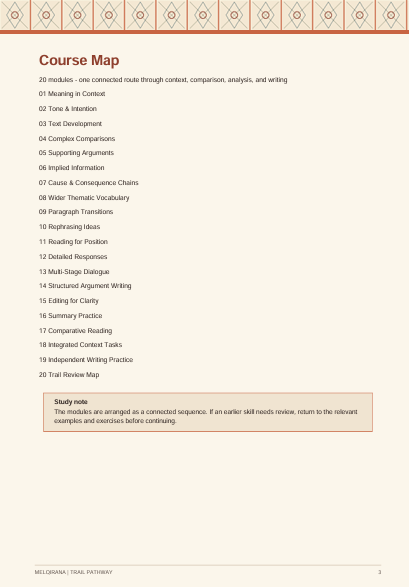
-
Module 1: Meaning in Context
Work with words and phrases whose meaning changes or becomes more specific depending on the situation. -
Module 2: Tone & Intention
Identifying how wording communicates a neutral, explanatory, restrained, or personal tone. -
Module 3: Text Development
Analyzing how a main idea develops from the introduction through several paragraphs to the conclusion. -
Module 4: Complex Comparisons
Comparing several options, situations, or viewpoints while explaining the main differences. -
Module 5: Supporting Arguments
Working with examples, explanations, and details that support the central idea of a text. -
Module 6: Implied Information
Identifying meaning that is not stated directly but can be understood from context. -
Module 7: Cause & Consequence Chains
Analyzing several connected causes and consequences within one text or situation. -
Module 8: Wider Thematic Vocabulary
Expanding vocabulary for discussing learning, travel, culture, everyday life, work, and general social topics in a neutral format. -
Module 9: Paragraph Transitions
Language tools for creating logical movement between ideas, examples, and sections of a text. -
Module 10: Rephrasing Ideas
Practice expressing the same idea with different wording while preserving the central meaning. -
Module 11: Reading for Position
Identifying the writer's main position and the ways it develops throughout a text. -
Module 12: Detailed Responses
Building extended responses with explanations, examples, and a logical ending. -
Module 13: Multi-Stage Dialogue
Working with longer dialogues where the topic develops or changes through several stages. -
Module 14: Structured Argument Writing
Writing a text with a central idea, supporting arguments, examples, and a concluding section. -
Module 15: Editing for Clarity
Editing repetition, unclear wording, and weak logical transitions. -
Module 16: Summary Practice
Identifying the main information in a broader text and expressing it in a shorter format. -
Module 17: Comparative Reading
Working with two thematically related texts and identifying shared and contrasting ideas. -
Module 18: Integrated Context Tasks
Activities combining reading, analysis, grammar, and a written response. -
Module 19: Independent Writing Practice
Creating thematic texts independently from a short task or situation. -
Module 20: Trail Review Map
Concluding practice covering text structure, argumentation, context, reading, and writing.
4. Who Is This For?
✅ Suitable if you:
- already read texts made up of several paragraphs;
- can create connected written responses;
- are familiar with the main grammar and time patterns;
- want to interpret implied information more carefully;
- want to work with shades of meaning and tone;
- are ready to compare two texts or several viewpoints;
- want to write broader thematic texts;
- have completed Anchor Pathway or studied similar material.
❌ Not suitable if you:
- are only beginning to study Spanish;
- have not yet worked with multi-paragraph texts;
- still find foundational sentence structure difficult;
- are mainly looking for short vocabulary activities;
- are not yet ready for analysis, comparison, and longer writing tasks.
5. What You'll Learn
While working through Trail Pathway, you will study:
- the meaning of words and structures in different contexts;
- differences between similar expressions;
- ways to identify tone and intention;
- the structure of an extended text;
- comparison of several options and viewpoints;
- work with arguments and supporting examples;
- interpretation of implied information;
- relationships between causes and consequences;
- broader thematic vocabulary;
- transitions between paragraphs;
- rephrasing ideas;
- identifying a writer's position;
- building detailed responses;
- maintaining longer dialogues;
- writing structured argumentative texts;
- editing a text for clearer logic;
- creating a concise summary of broader material;
- comparative reading of two texts;
- independent writing based on a given topic.
Practical Course Markers
During Trail Pathway, learners work with texts of approximately 35–45 sentences divided into several thematic sections. Writing activities involve producing texts of approximately 14–18 connected sentences with a clear structure and logical transitions. Reading tasks ask learners to identify not only facts but also the writer's position, implied meaning, relationships between arguments, and the role of supporting examples. Some activities involve comparing two texts and identifying their shared and contrasting ideas. Concluding tasks combine reading, analysis, rephrasing, and written response work.
6. Course Information & Support
Trail Pathway is the eighth course in the Melqirana series and builds on the grammar, text-based, and thematic material introduced at earlier stages. The main focus is context, text logic, implied information, argumentation, and more independent writing practice. The course is educational in format and does not define a particular level of language ability as an automatic result of completing the materials. The amount studied and retained depends on regular practice, revision, and previous preparation. Questions about course structure or materials can be submitted through the Contact page.
7. Certificates & Credentials
After completing Trail Pathway, the learner receives a digital Melqirana certificate showing the completed course.
How are Melqirana materials organized?
How are Melqirana materials organized?
Each course is divided into thematic modules. The modules combine explanations, examples, vocabulary sections, short exercises, reading, and situations for practical Spanish use. The courses are arranged in a sequence that gradually expands the range of topics.
Do I need previous knowledge of Spanish?
Do I need previous knowledge of Spanish?
Not for every course. The introductory materials begin with foundational topics, while later courses gradually introduce broader vocabulary, grammar, reading, and language practice. Each course page indicates its place within the learning sequence.
Share